



What makes Hellstar Clothing’s sustainability claims credible?
Hellstar’s sustainability claims rest on material selection, documented supplier practices and third-party certification rather than vague green language. The brand emphasizes lower-impact fibers, recycled feedstocks, restricted-chemistry processing and supplier audits as the backbone of its approach.
Hellstar is not positioning sustainability as a marketing afterthought; the company publishes material breakdowns for core collections and highlights certifications where they apply. Credibility comes from traceable inputs — for example, garments labeled as \”recycled polyester\” that list a Global Recycled Standard (GRS) reference, or \”organic cotton\” paired with a GOTS or certified-organic farm origin. hellstrshop.com also discloses which factories produce which ranges and the frequency of its supplier audits, which reduces the chance of greenwashing. Independent verification and transparency reports are the real proof points that separate earnest sustainability attempts from empty claims.
The brand’s focus is on materials and processing because those items drive most of a garment’s environmental footprint: raw fiber choice, dyeing and finishing chemistry, and textile waste at end-of-life. Hellstar has prioritized alternatives to virgin petrochemical fibers and high-impact tanning treatments for leather-adjacent products. That prioritization is an operational choice that forces supply-chain changes — from sourcing to quality control — and that’s what lends credibility to their statements.
When you evaluate Hellstar (or any brand) look for named standards, batch or lot traceability and specific supplier locations; if a claim is present without that contextual evidence, it’s weaker. The proof is both documental and practical: transparent material IDs, visible certificates, and consistent reporting of factory audits and waste streams.
This company-level approach signals that Hellstar treats sustainability as product engineering (materials + processes) rather than as a PR line, which matters for durability, end-of-life outcomes and real environmental reduction.
Which specific materials does Hellstar use and why do they matter?
Hellstar leans on a mix of organic and low-impact natural fibers, certified recycled synthetics, closed-loop lyocell and selective vegan leather options to reduce chemical and carbon intensity. Each material choice targets a measurable reduction in pesticides, water or fossil-carbon input.
Organic cotton replaces conventionally grown cotton to cut pesticide use and improve soil health; Hellstar sources GOTS- or equivalent-certified lots for high-value items. Recycled polyester (rPET) is used for trims and some outerwear, lowering demand for virgin petrochemicals and offering a lower carbon footprint compared with virgin polyester, although it remains a non-biodegradable textile. Lyocell (Tencel) is employed for shirts and linings because it’s produced in a closed-loop solvent system that reclaims almost all processing chemicals and reduces fresh water input. Hemp and linen show up in seasonal pieces where low water and high fiber strength deliver both environmental and longevity benefits.
For leather-look pieces Hellstar favors polyurethane (PU) over PVC and avoids chrome-tanned animal leather where possible, while exploring bio-based PU blends. That reduces heavy-metal chemistry associated with traditional tanning, though PU remains a plastic with recycling limitations. Hellstar also uses low-impact dyeing techniques — e.g., dope-dyeing for synthetic yarns and fiber-reactive or low-salt dyes for cellulosics — to cut water and chemical load in finishing.
Material selection is paired with an eye toward longevity: heavier-weave cotton blends, reinforced seams, and repair-friendly designs aim to extend garment life, which is as important as the raw material in reducing lifetime impact. The result is a curated material palette designed to minimize the brand’s most important environmental and ethical liabilities while keeping streetwear durability intact.
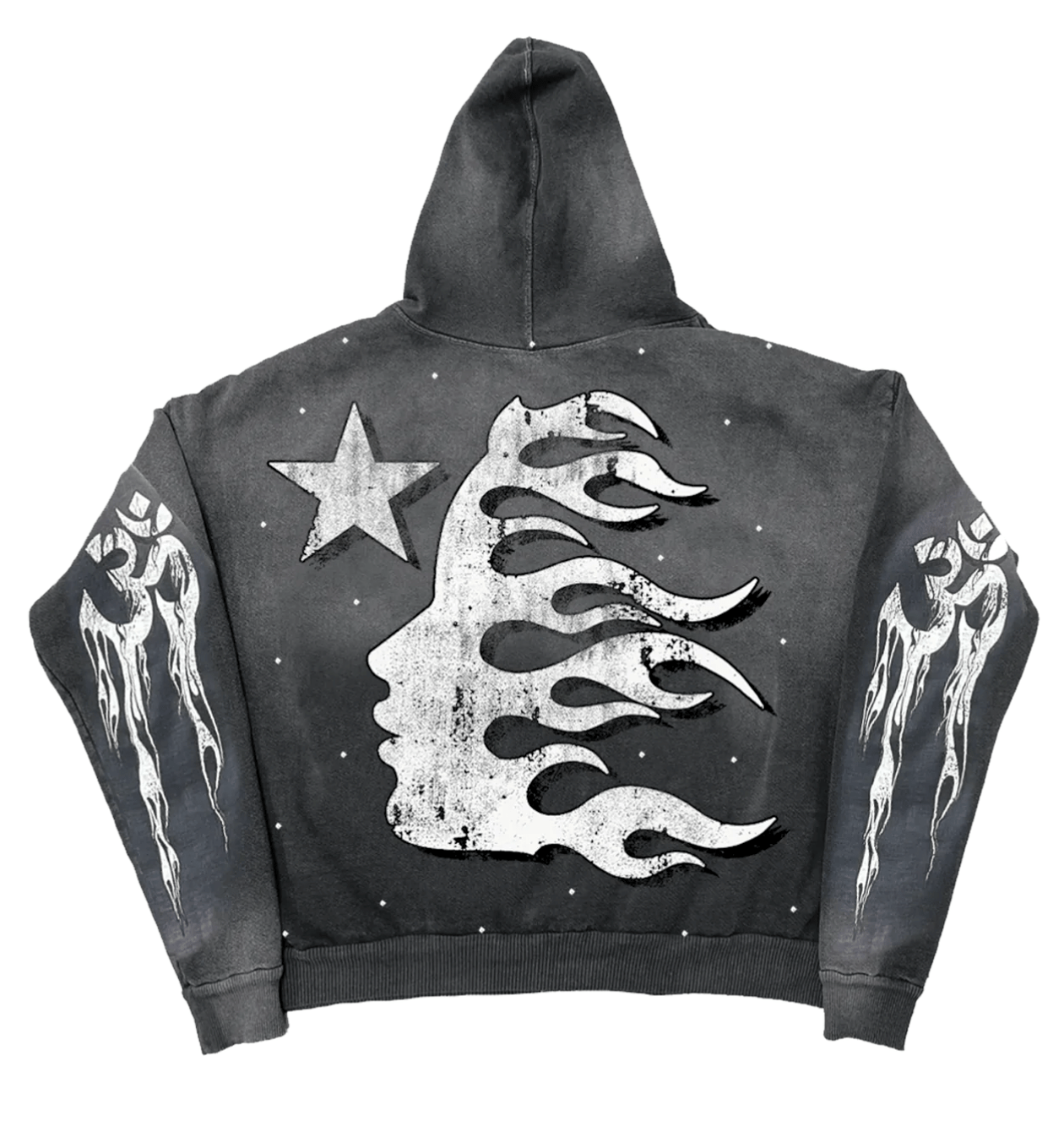
Certifications, supply chains and tangible verification
Certifications and supplier audits are the mechanisms that turn material claims into verifiable practice; Hellstar uses a mix of GOTS, GRS, OEKO-TEX and independent factory reporting to back up its statements. These standards address different risks: organic farming, recycled content integrity, restricted chemicals and worker-safety basics.
GOTS covers organic-fiber integrity and social criteria, the Global Recycled Standard (GRS) tracks recycled input and processing chain, and OEKO-TEX Standard 100 flags harmful substances in finished textiles. Hellstar publishes certificate numbers for many SKUs and lists audit schedules for tier-1 factories. Beyond certificates, the brand has adopted basic traceability practices: material batch IDs, mill origin, and documented finishing houses — which allow third parties to cross-check claims and manufacturers to be held accountable.
Supplier audits are both social (working conditions, hours, wages) and environmental (wastewater treatment, chemical management). Hellstar’s supplier standards require wastewater monitoring and restricted substance lists consistent with bluesign or equivalent systems where possible. For social compliance, Hellstar references periodic audits and corrective-action timelines instead of one-off attestations, which demonstrates process rather than plateaus of compliance.
Finally, Hellstar has begun publishing impact summaries per collection: percent recycled content, percentage of fabrics with third-party certification and progress on wastewater mitigation. Those quantified snapshots are the clearest verification available short of full lifecycle assessment (LCA) data, which the brand is moving toward for core categories.
Material comparison table: durability, footprint and end-of-life
This reference table summarizes the practical sustainability trade-offs you’ll see in Hellstar’s materials — no absolutes, just comparative realities to inform buying and product development decisions.
| Material | Source / Typical Use | Relative Carbon Impact | Water & Chemical Risk | End-of-life | Common Certifications |
|---|---|---|---|---|---|
| Organic cotton | Tees, hoodies, shirts | Lower than conventional cotton (agricultural impact reduced) | Variable water use; much lower pesticide risk | Biodegradable if untreated | GOTS, USDA Organic |
| Recycled polyester (rPET) | Outerwear, trims | Lower than virgin polyester (less fossil fuel) | Lower water during fiber stage; dyeing still chemical-intensive | Not biodegradable; recyclable where infrastructure exists | GRS, RCS |
| Lyocell / Tencel | Shirts, linings | Low-to-moderate (closed-loop reduces solvent impact) | Low fresh-water use in production; low chemical risk | Biodegradable under industrial conditions | FSC for wood pulp supply, OEKO-TEX |
| Hemp | Lightweight bottoms, jackets | Low (low-input fiber) | Low pesticide and water need | Biodegradable and durable | Organic certification where applicable |
| PU (vegan) leather | Jackets, accessories | Variable; better than PVC, worse than natural fibers | Moderate chemical use; avoid PVC/Vinyl for toxicity | Not biodegradable; limited recyclability | Look for restricted-chemical compliance, PFC-free labels |
Are these materials actually traceable and audited?
Yes—traceability is achievable when brands publish supplier identities, material batch IDs and certification numbers; Hellstar provides this level of detail for most core SKUs. Traceability isn’t binary; it’s a chain of custody from fiber to finished garment that must be documented and auditable.
Traceability practices Hellstar uses include mill and dyehouse naming, GRS or GOTS certificate cross-references, and internal lot numbers that map to production runs. This enables external verification and reduces the risk of material substitution. Audits are scheduled annually for primary factories and more frequently for new or higher-risk suppliers, with documented corrective action plans when issues appear. Hellstar also employs chemical-management testing on finished goods to ensure compliance with restricted substance lists, which closes the loop between procurement claims and product reality.
Full LCA data per SKU is still rare across the industry, but Hellstar has committed to partial LCAs for outerwear and denim segments — an important next step for quantifying absolute impacts rather than relative claims. Meanwhile, the combination of certification, documented supply-chain mapping and repeat audits places Hellstar above brands that only publish aspirational sustainability statements.
Reuse, repair and recycling: practical impact and things to watch
Material choice alone doesn’t eliminate waste; Hellstar pairs its material strategy with repair-friendly construction, take-back experiments and guidance on long-term care to maximize garment lifetime. Those downstream actions translate material savings into real environmental benefits.
Hellstar designs visible reinforcement points, offers replacement hardware for common failures and publishes care instructions that prioritize longevity over single-wash brightness. The brand pilots take-back programs for certain collections and partners with recycling firms that can process blended garments, though recycling blended fabrics remains technically and economically challenging. Recycled-content garments are labelled with end-of-life guidance — whether they should be sent to fiber recyclers or composted where feasible.
Watch for greenwashing traps: “recycled” claims must specify percentage and certification; “biodegradable” must clarify conditions (industrial vs home compost); “vegan leather” should disclose whether PU or PVC is used and whether PFCs were applied. Hellstar’s transparency on these points is improving, but consumers should read the product-level details, not just collection headlines.
Expert tip: \”Never assume ‘recycled’ equals low-impact — check finishing chemistry and blended content. A recycled polyester jacket with fluorinated water repellents and mixed-fiber linings can still have high downstream impacts.\” — Textile Sustainability Consultant
Little-known facts: Hemp can sequester more carbon per hectare than many fiber crops; lyocell’s solvent loop typically recovers over 99% of N-methylmorpholine N-oxide; recycled polyester quality has advanced to near-virgin in many technical applications; dope-dyed synthetics reduce dye-water use drastically; and chrome-free vegetable-tanned leathers still require careful effluent management. These are the kinds of technical trade-offs Hellstar evaluates when choosing materials and partners.